Abstract
Fluorescent azaheterocycle derivatives are invaluable materials in optoelectronics, having a fascinating potential for practical applications. Obtaining highly fluorescent azaheterocyclic derivatives with extended p-conjugation are on great demand in the construction of Organic Light-Emitting Diode (OLED) devices, lasers, electroluminescent materials, sensors and biosensors, semiconductor devices, etc. As fluorophores azaheterocyclic derivatives are chosen and used in a large variety of medical applications because of their exceptional properties, which include their small size, improved photostability, wide and tunable spectrum range, and frequently high brightness. The emphasis of this work was to design, synthesize and characterize azaheterocyclic derivatives with potential applications in optoelectronic devices (acting in the blue region of spectra, around 400 nm) and in medicine, as sensors/biosensors acting in the so-called red “medical optical window”, around 680-700 nm. In this respect, we obtained different classes fused pyrrolo- (di)- azine heterocycles, containing in the same molecule both a π-excessive pyrrole and a π-deficient (di)-azine ring with one bridgehead nitrogen atom. These compounds have an extended π- conjugation in molecule, and according to the number of cycles and chromophore substituents, the fluorescence is shifted from highly blue (emission around 380 – 400 nm) to intense red emission (around 630-700 nm). Our compounds have exhibited high fluorescence, little self-quenching, proper energy levels, pure RGB color, and high stability. The absorption and fluorescence properties of our fused pyrrolo- (di)- azine heterocycles are solvent sensitive and depend on the nature of the substituents at the azaheterocycle, and on the positions of the substituents.
Acknowledgments: The authors are thankful for financial support to INTEGRATED INTERDISCIPLINARY SYSTEM FOR THE IMPLEMENTATION OF SUSTAINABLE DEVELOPMENT ACTIVITIES IN THE NORTH-EASTERN REGION OF ROMANIA (SIDNER), code SMIS 337821, contract no. 716/04.06.2025.
Biography
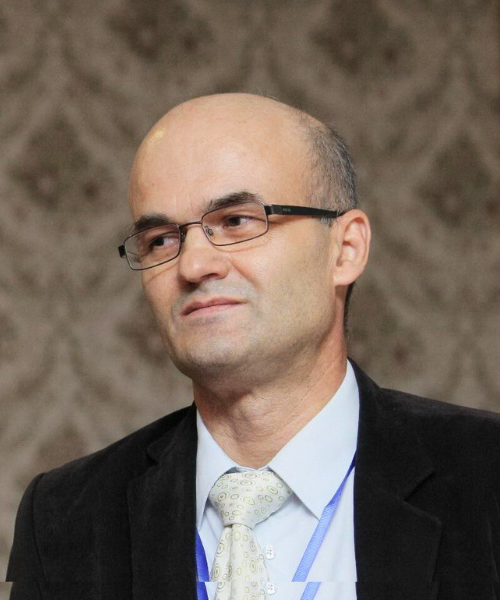
Dr. Mangalagiu is a professor of organic and medicinal chemistry to Alexandru Ioan Cuza University of Iasi, Romania. Prof. Mangalagiu served the university as Vice-Rector for research, Dean, Vice-Dean, Head of Organic Chemistry Department, etc. (at Faculty of Chemistry). He has nearly 30 years of experience in research, focused on the area of Heterocycles Compounds. He has over 200 papers, 15 patents, 6 international chapter books, a Hirsh index of 32 (WOS), 36 (Google), etc. He was Visiting Professor and/or invited speaker to prestigious foreign universities (Ludwig Maximilianus University Munchen, Technische Universität Braunschweig, University of Florence, Universite D’Angers, University of Viena), awarded with numerous prizes and honours: DAAD and NATO award, Costin D. Nenitescu Medal (Romanian Society of Chemistry), Ioan Tanasescu Award for Excellence in Organic Chemistry (American Chemical Society in association with the Romanian International Chapter), Award for Excellence in Research (Alexandru Ioan Cuza University of Iasi), Grand Prize Euroinvent (Euroinvent, Romania), Special Award of Croatian Association of Inventors, etc.